Stop Painting and Start Resolving
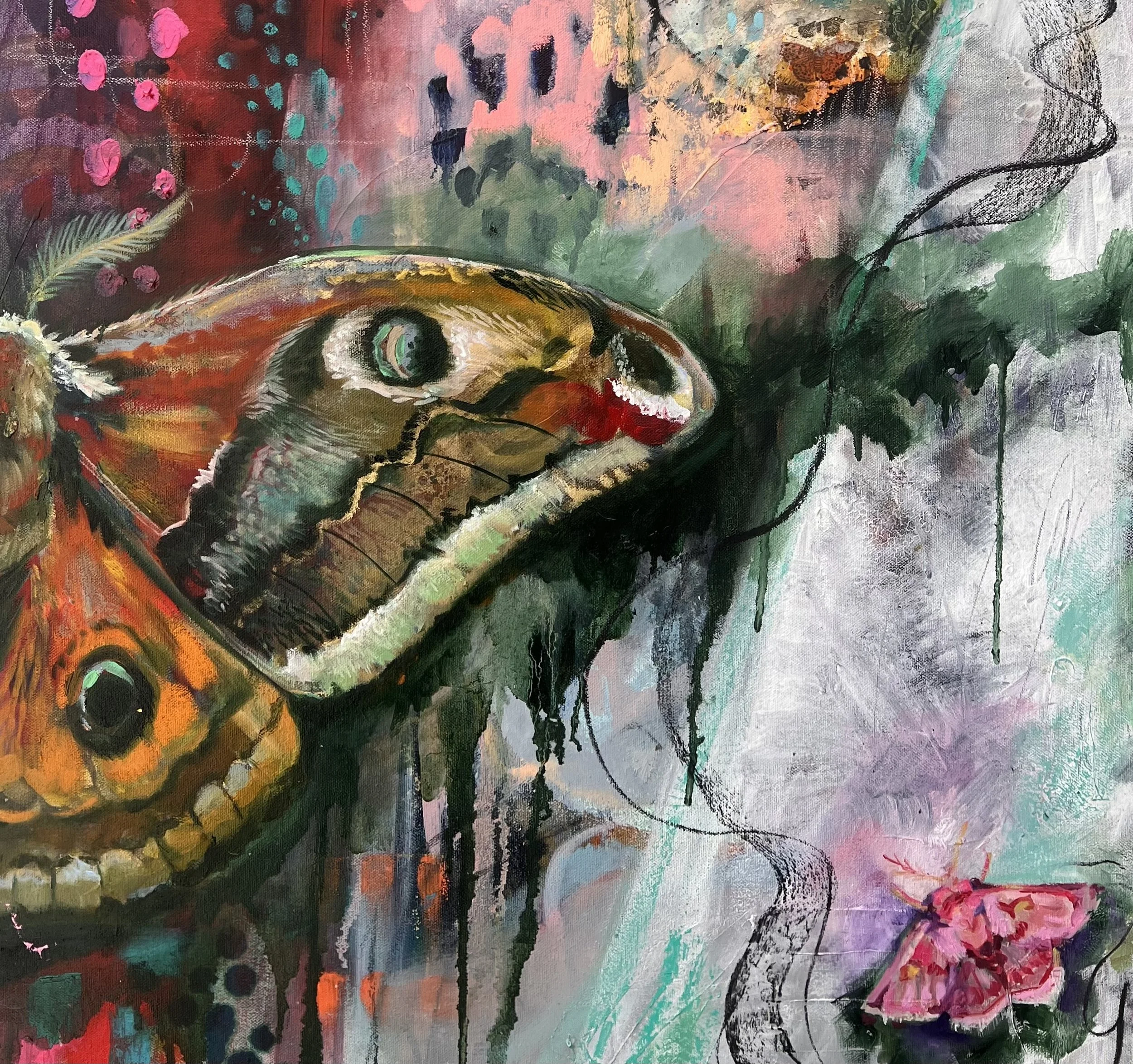
In 2025, I realized that walking away from unfinished paintings wasn’t discernment—it was avoidance. Learning to resolve what felt unresolved, unclear, and unfinished on the canvas changed not only my practice, but the way I face discomfort in life.
Toward the end of 2025, I began to reflect on what kind of year it truly was. It wasn’t a simple one—it was layered, emotional, and often contradictory. There were milestones I’m proud of, like completing my first portfolio for the Milan Art Institute’s online course. There were countless hours spent in the studio, and an ongoing (and still unresolved) search for my artistic voice and style.
Each painting from that year carries a story. Some remained unresolved, unclear, and unfinished. Others came together exactly as I had imagined—clear, intentional, and aligned with my original vision. But many never left the studio. Some were abandoned halfway through. Some were finished but quietly dismissed.
A recurring belief kept surfacing: I didn’t finish enough paintings—and when things didn’t work, I gave up.
When a painting resisted me—when it didn’t flow the way others had—I assumed something was fundamentally wrong with it. I convinced myself it wasn’t worth the time to fix. Walking away felt easier than staying. I thought abandoning the canvas was a form of discernment, when in reality, it was avoidance.
Then I began learning about resolving a painting.
Resolving means sitting in silence with the work. Looking—really looking—at what remains unresolved, unclear, or unfinished. The composition. The color story. The clarity of the message. The focal point. The texture. Instead of reacting, you observe. Instead of fleeing, you stay.
To my surprise, resolving turned out to be gentle. Even pleasant.
I started pulling canvases out of what I jokingly called the grave. I studied them. I asked questions instead of passing judgment. I didn’t try to save them all—some didn’t need saving—but I tried to understand them. And in doing so, something shifted. Fixing what wasn’t working became a revelation rather than a failure.
This realization didn’t stop at painting.
I began noticing the same pattern in my life. In the months leading up to this artistic breakthrough, I had already started resolving things that no longer worked for me: relationships that only flowed one way, habits of retreating into solitude whenever discomfort appeared, avoiding confrontation under the disguise of independence.
I started wondering—was my inability to resolve certain things in my paintings a reflection of what I hadn’t yet learned to resolve in myself?
I don’t have a definitive answer. But I know this: resolving changes everything.
When you resolve, you grow. You see differently. You access a version of yourself that wasn’t available before. You break cycles instead of repeating them. Whether on canvas or in life, resolution isn’t about perfection—it’s about presence, courage, and commitment to staying when things get uncomfortable.
Conclusion
Resolving has become an essential part of my practice—not just as an artist, but as a person. It taught me that walking away is easy, but staying with the unresolved is where transformation happens. In art, resolving turns confusion into clarity. In life, it turns patterns into choices.
I no longer see unfinished paintings as failures. I see them as conversations waiting to be continued. And I no longer fear the moment when things feel unresolved—because now I know that’s exactly where the real work begins.
The Art in the Details
Sometimes I wonder where the art of details has gone — those little traces of imagination that once lived in architecture, colours, and craftsmanship. During a weekend getaway, I found my answer wandering the streets of Old Quebec, camera in hand and heart full of inspiration.
This weekend, we decided to take a short but well-deserved break away from home. Nothing extravagant — just something close enough to feel easy, yet far enough to breathe differently. It gave me the perfect chance to see my best friend who recently moved — not too far from Quebec, but far enough that visits feel like small adventures.
On the way back from our Tadoussac trip, we passed by Old Quebec. As the car rolled along those historic streets, I turned to my husband and said, “I want to come back soon.” It wasn’t the first time I’d felt that pull. There’s something magnetic about Old Town — a warmth, a richness, a texture that stirs something deep inside me.
For a long time, I couldn’t quite put my finger on why those getaways meant so much to me. Then, while reading a blog from another artist, I understood: it’s the details.
The world used to be filled with them — small gestures of creativity and intention that made life itself a work of art. You could see it in the shape of a window frame, in the curve of an old doorknob, in the way a craftsman carved meaning into wood or stone. Every building carried a piece of someone’s imagination. Every corner told a story.
But over time, we traded that for convenience. Industrialization came with efficiency, but also a quiet loss. Slowly, the world around us became more uniform — simple, yes, but stripped of life. Walls turned flat and grey. Materials became synthetic. And somehow, the art of living with beauty faded from our everyday lives.
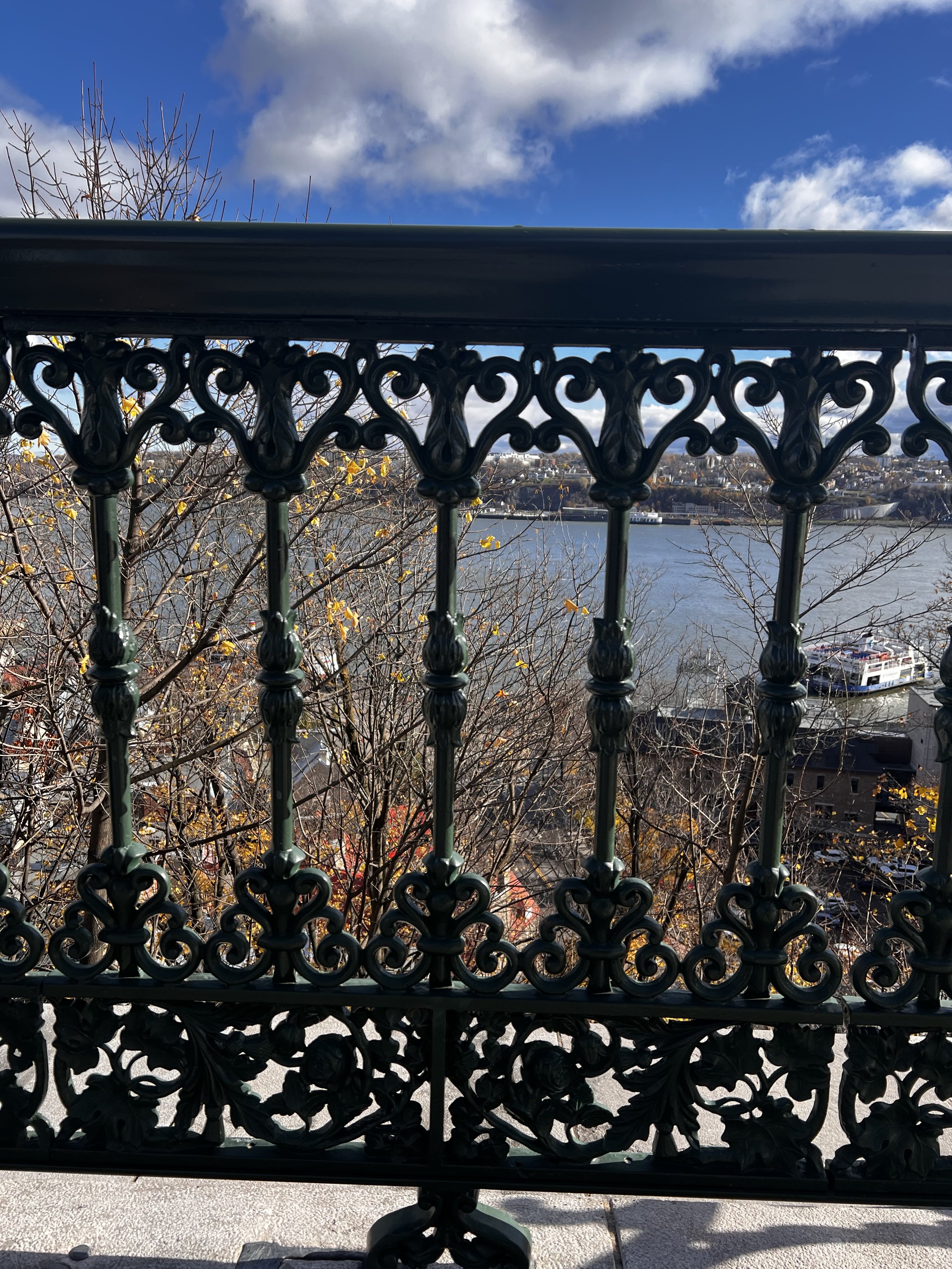
When I walk through Old Quebec, I feel that loss and that longing. I find myself stopping to photograph the carvings on a façade, the rust patterns on an iron balcony, the way sunlight touches the worn stone of a century-old wall. Each of these details speaks to me. They remind me of what humanity can do when it takes the time to create — to imagine — to care.
I think that’s why I’m an artist.
A part of me refuses to accept that this transition — from craftsmanship to conformity — is progress. I believe beauty has a purpose. It makes us feel alive.
And it turns out, I’m not alone in thinking this. Research shows that living surrounded by art, colours, and textures has real effects on our well-being. Studies in environmental psychology have proven that aesthetic environments reduce
When Life Decides You’re Ready
Last week was Halloween, and I found myself at my kids’ school, volunteering.
Not because I had to, but because creating joy for children feels like second nature to me —
a small act of love, a spark of creativity shared.
Another mom was there, vibrant and full of energy,
a life coach who spoke of one of her clients dreaming of selling art.
Before even starting, that client was already imagining
how she’d sell a painting for a thousand dollars.
It made me smile — and brought me back through memory lane.
I often say I started a year ago,
and people sometimes misunderstand what that means.
Yes, about a year and a half ago, I made a decision —
to pick up my brush and create every single day.
Was I ready to sell? Absolutely not.
Did I sell my first painting?
No — I think I actually burned it, it was that bad!
But truth is, my creativity didn’t start then.
It’s been part of me since I can remember.
I was the girl who drew at recess,
who made friends with everyone through her pencil and imagination.
Years later, pregnant with my second child,
a woman approached me at a wedding.
She told me she still had a folder filled with my old drawings,
kept safely in a shoebox all these years.
That’s when I realized — life had always been guiding me back to art.
Whenever times were hard,
whenever money was tight,
I always found myself creating something for others —
a small gift, a painting, a piece of light to make someone feel special.
Then came a difficult year.
Teaching wasn’t enough to carry me through.
So I made a choice:
to start again, as if I had never painted before.
I joined a program — The Mastery Program —
and, after convincing my husband with all the passion I could gather,
we made it happen.
Weeks passed.
My studio filled with canvases —
each one a reflection of my persistence and my rediscovered joy.
I didn’t care about selling;
I cared about learning, about getting better.
I’ve never liked being a beginner —
I needed mentors, guidance, truth.
Twelve weeks of classical oil painting came first,
then a new chapter: mixed media.
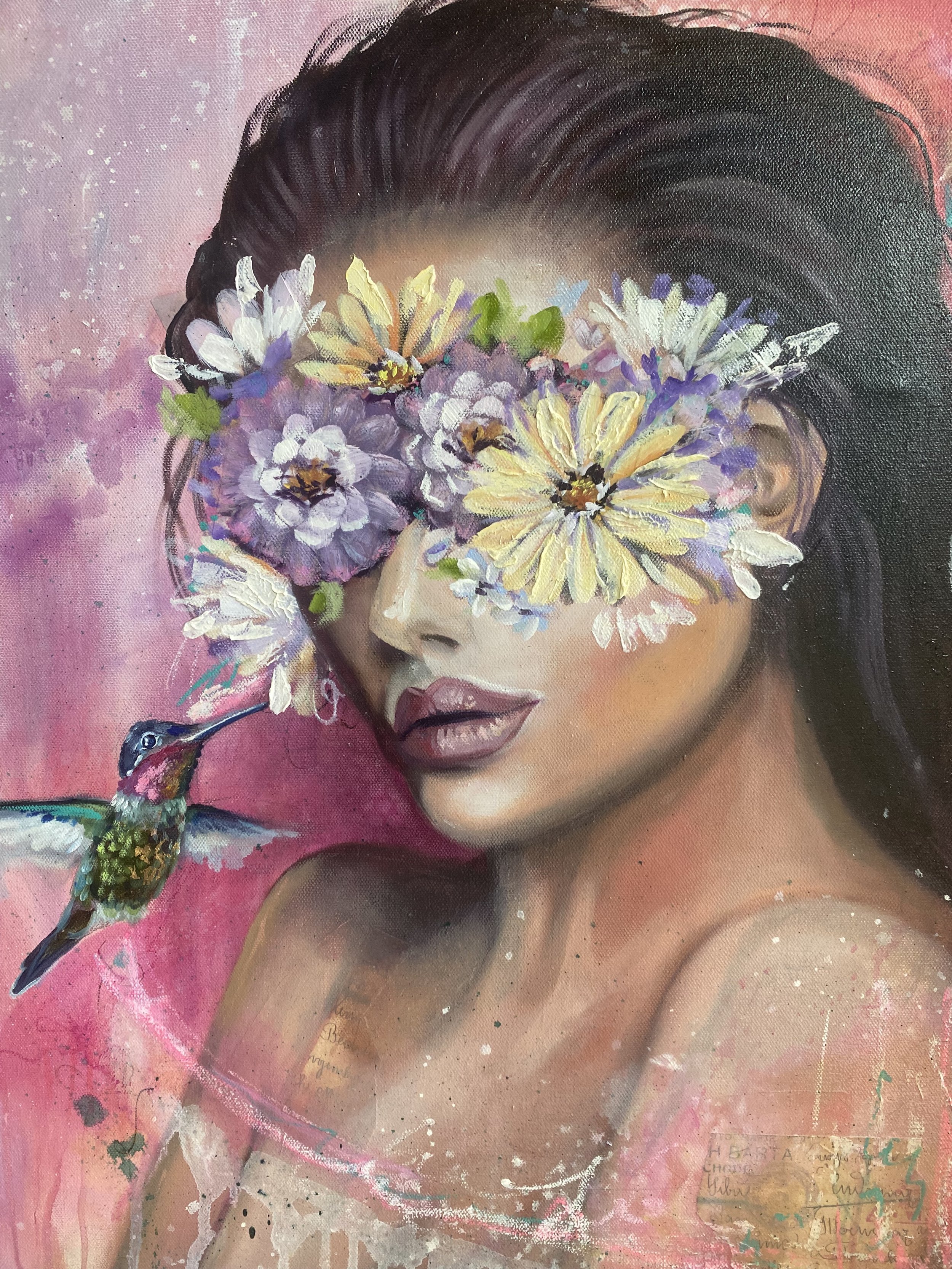
That’s when she was born —
a woman on canvas with flowers for eyes,
a symbol that through our gaze
we can choose to see life as beauty,
if only we want to.
When she was done, I knew she was special.
I showed my mom, proud and a little nervous.
“How much would you sell her for?” she asked.
I told her my price,
and she smiled and said,
“Sold.”
My first sale — to my mother.
It wasn’t planned.
It was simply life saying: you’re ready.
From there came more women:
one with lemons,
another — a naked back, a symbol of transformation.
She was called Metamorphosis —
the caterpillar becoming the butterfly.
I brought her to a café,
and the owner fell in love at first sight.
She said the price was fair and bought it on the spot.
Again, life whispered: you’re ready.
The lesson in all this?
Create for yourself.
Fill your world with beauty, patience, and joy.
Don’t chase the sale —
let life decide when it’s time.
Because when you create with love,
your art will find the hearts it’s meant for.
And in that quiet unfolding,
you’ll realize —
good things grow slowly.
They bloom when you’re ready to receive them. 🌸
Summer of lost and found
This post took me a long time to share. I wasn’t sure how to open up about it — I’m not the type to share much of my personal life online. But I think being human and staying humble allows others to see that we’ve all been there at some point.
After one of my shows in Montreal, I felt completely lost. Not a single piece of art sold, even though it was one of my biggest shows to date. I had worked so hard on that portfolio — part of my Mastery Program — but deep down, I knew I wasn’t where I was meant to be.
That feeling of failure slowly started to affect more than just my art. I lost a little of myself, and with that, a bit of my connection with my husband. I was so focused on questioning my purpose — how I got there, how to find my way back — that I couldn’t see how much it was affecting us. For the first time in 15 years, I felt like my relationship was truly at risk.
Then, one day, I realized I had been painting things that didn’t represent me anymore. So I gathered all my unfinished works and decided to face them one by one. I knew that to find my positive energy again, I had to transform each of those paintings.
Something shifted inside me. I started to notice the small things — a perfect brushstroke, a clean line — and began to practice gratitude for every small victory. That’s when I truly understood something no one tells you: being an artist comes with deep challenges. If you’re not ready to face them, you’re not ready to grow.
Then came the breakthrough — River Within. It became one of my most visited works online. After that, Lily and Silence, which I later donated to a foundation supporting families in need. And finally, Home.
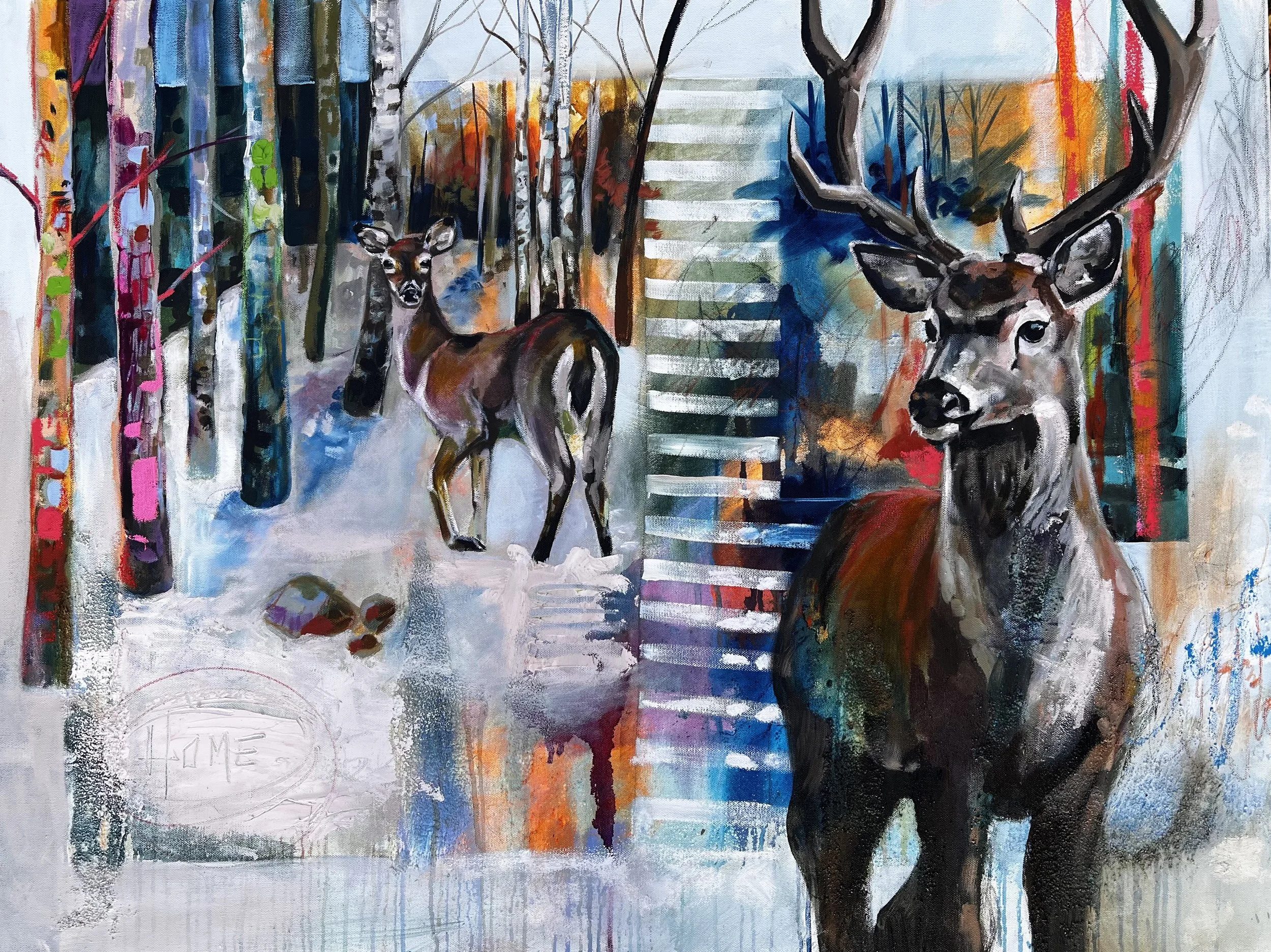
Home is the story I’m sharing with you right now — the story of someone who got lost and found her way back. Not the same person, but someone stronger. In this piece, I chose to represent myself as a stag, not a doe — a symbol of strength, maturity, and renewal. I painted it intuitively, not realizing until later that the stag embodied everything I was becoming.
This summer taught me that sometimes losing yourself is part of finding your true path. Every brushstroke, every challenge, and every tear had a purpose — to bring me home, to the artist and person I was always meant to be.
After one of my shows in Montreal, I felt completely lost. Not a single piece of art sold, even though it was one of my biggest shows to date. I had worked so hard on that portfolio — part of my Mastery Program — but deep down, I knew I wasn’t where I was meant to be.
That feeling of failure slowly started to affect more than just my art. I lost a little of myself, and with that, a bit of my connection with my husband. I was so focused on questioning my purpose — how I got there, how to find my way back — that I couldn’t see how much it was affecting us. For the first time in 15 years, I felt like my relationship was truly at risk.
Then, one day, I realized I had been painting things that didn’t represent me anymore. So I gathered all my unfinished works and decided to face them one by one. I knew that to find my positive energy again, I had to transform each of those paintings.
Something shifted inside me. I started to notice the small things — a perfect brushstroke, a clean line — and began to practice gratitude for every small victory. That’s when I truly understood something no one tells you: being an artist comes with deep challenges. If you’re not ready to face them, you’re not ready to grow.
Then came the breakthrough — River Within. It became one of my most visited works online. After that, Lily and Silence, which I later donated to a foundation supporting families in need. And finally, Home.
Home is the story I’m sharing with you right now — the story of someone who got lost and found her way back. Not the same person, but someone stronger. In this piece, I chose to represent myself as a stag, not a doe — a symbol of strength, maturity, and renewal. I painted it intuitively, not realizing until later that the stag embodied everything I was becoming.
This summer taught me that sometimes losing yourself is part of finding your true path. Every brushstroke, every challenge, and every tear had a purpose — to bring me home, to the artist and person I was always meant to be.